
How to Stop Overthinking at 3am
Your brain is louder at 3am because it has nothing else to compete with. Here is what actually helps when the thoughts will not stop.
Educational content for everyday anxiety patterns by Sebastian Cochinescu, Founder, Anima Felix. It is not diagnosis, therapy, or emergency care. Learn how we approach anxiety support.
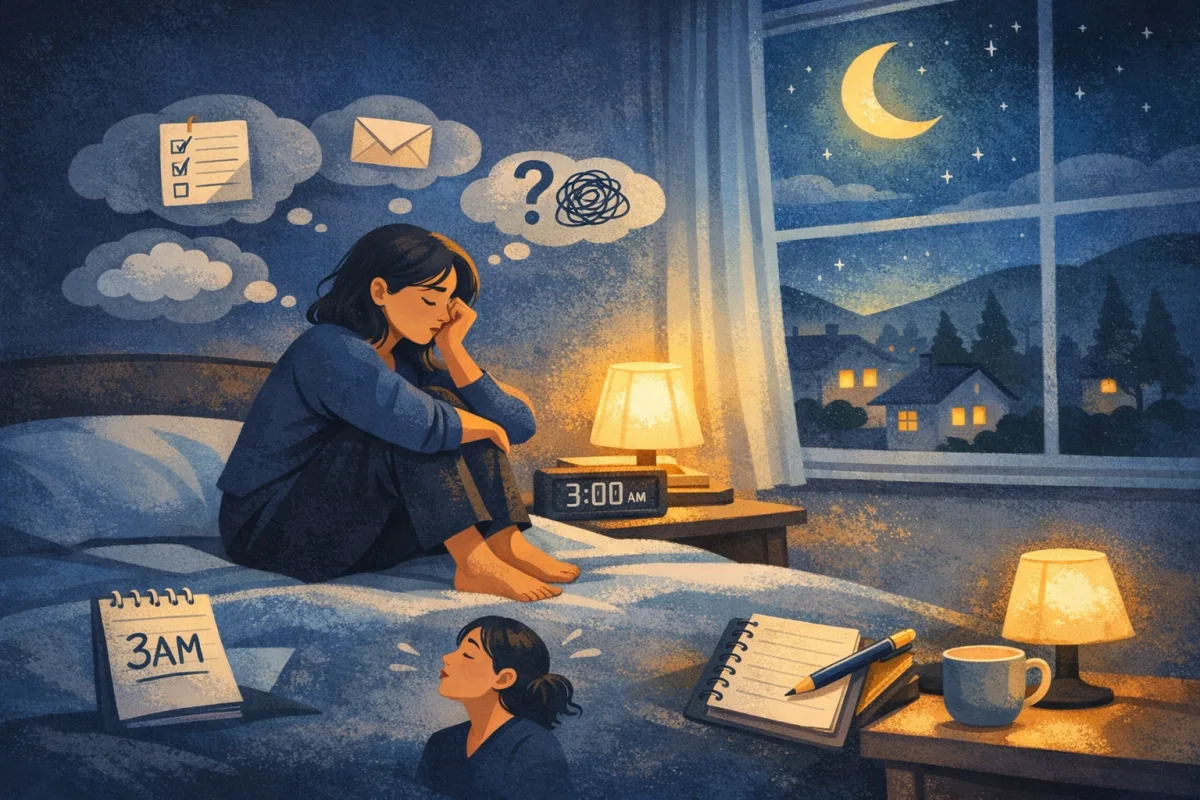
It is 3am. You are wide awake. The thoughts are not new - they are the same worries from the day, but now they feel urgent and unsolvable. You solved one, and your brain found three more. The silence of the night makes everything louder. This is one of the most common anxiety patterns people describe, and it has a name: nocturnal overthinking. Understanding why it happens is the first step to breaking the cycle.
Why your brain spirals at night
During the day, your brain has distractions: work, conversations, tasks, noise. At night, those buffers disappear. The prefrontal cortex - the part of your brain responsible for rational thinking and perspective - is less active when you are tired. Meanwhile, the amygdala (your threat-detection center) stays alert.
This creates a perfect storm: reduced rational thinking plus heightened threat detection plus zero distractions. The result is that a manageable worry from the day ("I should reply to that email") becomes an existential crisis at 3am ("I am going to lose my job and everything will fall apart").
Cortisol, your stress hormone, also follows a natural cycle. It begins rising around 2-4am in preparation for waking. If your baseline stress is already elevated, this cortisol bump can be enough to wake you - and once the thoughts start, the adrenaline keeps you up.
What does not work (and why people keep trying it)
Telling yourself to stop thinking does not work because suppression increases the frequency of the unwanted thought - this is called the "white bear effect" (try not to think of a white bear, and it is all you can think about).
Checking your phone makes it worse because blue light suppresses melatonin, and scrolling introduces new stimulation that your tired brain will convert into new worries.
Lying in bed waiting to fall back asleep trains your brain to associate the bed with being awake and anxious. Sleep researchers call this "conditioned arousal" - your bedroom becomes a cue for wakefulness instead of rest.
What actually helps: a 3am action plan
Step 1: Name it. Say to yourself (or type it): "This is the 3am pattern. My brain is doing the thing." Labeling the experience as a pattern - not as a real emergency - activates your prefrontal cortex and reduces the emotional charge.
Step 2: Breathe first, think later. Use a slow breathing pattern: inhale for 4 counts, hold for 4, exhale for 6. This activates your parasympathetic nervous system (the "rest and digest" mode) and directly counteracts the fight-or-flight response that is keeping you alert. Even 2-3 minutes makes a measurable difference.
Step 3: Dump the thoughts. Write down or type every worry - not to solve them, but to externalize them. When the thought is on paper (or on a screen), your brain no longer needs to hold it in working memory. You have given it a place to live outside your head.
Step 4: If you are still awake after 15-20 minutes, get up. Go to a different room, do something low-stimulation (read a physical book, sit with dim light), and return to bed only when you feel sleepy. This breaks the bed-anxiety association.
Building a longer-term pattern
The 3am spiral is usually a symptom of daytime anxiety that has not been processed. If you consistently wake with racing thoughts, consider whether you are giving your brain enough "processing time" during the day.
A 10-minute evening wind-down - writing down tomorrow's worries, doing a quick anxiety check, or using a breathing exercise - can significantly reduce the chance of a 3am wake-up. The goal is not to eliminate worry, but to give it a scheduled container so it does not ambush you at night.
Anima Felix includes tools designed for exactly this pattern: the quick anxiety check helps you name what is happening, the calm breathing flow settles the body, and the chat support gives you a place to externalize the loop without needing another person at 3am.
Your brain is not broken. It is running a protection pattern at the wrong time. The goal is not to silence it - it is to give it what it needs so it can stand down.
Frequently asked questions
Why do I always wake up at 3am with anxiety? +
Cortisol (your stress hormone) naturally begins rising between 2-4am. If your baseline stress is elevated, this bump can wake you. Once awake, the combination of reduced rational thinking and heightened threat detection creates the overthinking spiral.
Is 3am overthinking a sign of an anxiety disorder? +
Occasional night waking with racing thoughts is common and does not necessarily indicate a disorder. If it happens most nights and significantly impacts your daytime functioning, it is worth discussing with a healthcare professional. Tools like the GAD-7 assessment in Anima Felix can help you track the pattern.
Should I use my phone when I wake up anxious at night? +
Scrolling social media or news makes it worse. But using a specific tool - like a guided breathing exercise or a thought dump in a notes app - can help. The key is purposeful use (one task, then put it down) versus open-ended scrolling.
How long does it take to break the 3am overthinking habit? +
Most people notice improvement within 1-2 weeks of consistent practice (evening wind-down, breathing exercises, thought dumping). The pattern did not develop overnight, and it will not disappear overnight - but each night you respond differently, the pattern weakens.
Author
Sebastian Cochinescu · Founder, Anima Felix
Founder of Anima Felix. Writes about everyday anxiety patterns, practical calming tools, and how conversational product design can support people in anxious moments.
Read author profileWhere Anima Felix fits
If nights are when the loop gets loudest
Anima Felix is useful here because it gives you a low-friction place to start: a quick check-in, a calming exercise, or voice support when thinking in full sentences feels too hard.
More from the blog
What Is an Anxiety Loop?
Worry creates tension. Tension creates more worry. The loop does not stop because the brain thinks it is keeping you safe. Here is how the cycle works.
Practical toolsGrounding Exercises for Panic Attacks
When a panic attack hits, your brain loses contact with the present. Grounding exercises reconnect you to what is real and safe, right now.
Relationship anxietyRelationship Anxiety vs Real Problems: How to Tell the Difference
The hardest part of relationship anxiety is that it mimics real concern. Here is how to tell whether the alarm is a pattern or a signal.