
Why Does Anxiety Get Worse at Night?
Nighttime anxiety is not random. Your brain, your hormones, and the absence of daytime structure all work together to make worry feel louder after dark.
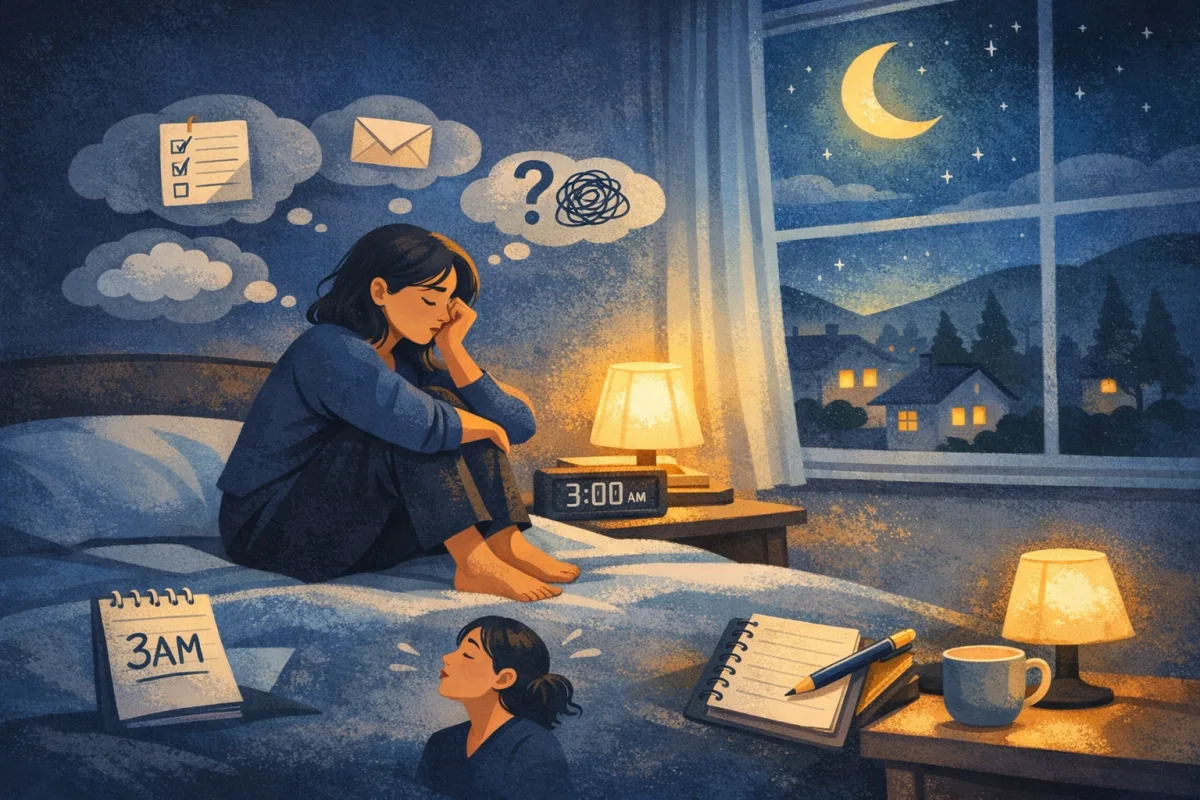
If your anxiety reliably gets worse once the sun goes down, you are not imagining it. Nighttime anxiety is one of the most commonly reported anxiety patterns, and it has real biological and psychological explanations. Your brain is not suddenly more anxious at night because your problems got worse - it is more anxious because the conditions that keep anxiety manageable during the day disappear one by one as evening arrives. This article explains the specific reasons why night amplifies anxiety, so you can understand the pattern rather than just endure it.
Your prefrontal cortex clocks out before you do
The prefrontal cortex is the part of your brain responsible for rational thinking, perspective-taking, and impulse control. It is what lets you hear a worry during the day and respond with "that is probably fine" instead of spiraling. But this region is the most energy-hungry part of your brain, and it fatigues over the course of the day.
By evening, your prefrontal cortex is operating on reduced capacity. You have spent the day making decisions, managing emotions, solving problems, and filtering stimuli. This is not a failure of willpower. It is what happens when your brain has already spent hours regulating stress and making judgment calls.
Meanwhile, your amygdala - the threat-detection center - does not fatigue the same way. It is designed to stay alert regardless of how tired you are (from an evolutionary perspective, nighttime was when predators were active, so vigilance needed to persist even when cognition slowed). The result is a lopsided brain at night: your alarm system is fully operational, but your "it is probably fine" system is running on fumes.
This is why a worry that felt manageable at 2pm can feel catastrophic at 10pm. The worry did not change - your brain's ability to contextualize it did.
Cortisol and the stress hormone cycle
Your body runs on a roughly 24-hour hormonal cycle called the circadian rhythm, and cortisol - your primary stress hormone - is a central part of it. Cortisol peaks in the early morning (around 6-8am) to help you wake up and feel alert. It then gradually declines throughout the day, reaching its lowest point in the late evening.
This sounds like it should make you less anxious at night, and for many people it does. But if your baseline stress level is chronically elevated - which is common with generalized anxiety, work stress, financial pressure, or ongoing relationship tension - the evening cortisol drop creates a withdrawal-like effect. Your body has been running on stress hormones all day, and when they dip, you do not feel calm. You feel unsettled.
There is also a second cortisol phenomenon relevant to nighttime anxiety. Cortisol begins rising again around 2-4am in preparation for the next day. If your stress baseline is already high, this pre-dawn rise can push you over the waking threshold, leaving you alert and anxious in the early hours with no obvious trigger. Your body woke you up not because something happened, but because its chemical alarm clock rang too early.
The silence problem
During the day, your brain constantly processes external stimulation: conversations, tasks, traffic, notifications, decisions, interactions. This stimulation occupies attentional bandwidth, leaving less room for worry to dominate.
At night, the external world quiets. The tasks are done. The conversations are over. The house is still. And your brain - which has been waiting all day to process unfinished business - finally has an open channel. This is when it surfaces the worries, regrets, and unresolved tensions that were queued behind the day's activities.
This is not your brain being cruel. It is actually doing its job. The brain is a pattern-completion machine - it wants to resolve open loops, reconcile contradictions, and predict future problems. During the day, it cannot do this because you are busy. At night, you are finally available, and the brain takes the opportunity.
The problem is that the brain does this processing through the lens of the fatigued, cortisol-depleted, amygdala-dominant state described above. So the "processing" is not calm reflection - it is anxious rumination. The brain is running its worry queue through a threat filter, and everything comes out sounding like an emergency.
Behavioral patterns that reinforce nighttime anxiety
Beyond the biological factors, several common nighttime behaviors make the pattern worse without people realizing it.
Screens before bed increase arousal. Blue light suppresses melatonin, the hormone that signals sleepiness, but more importantly, content creates new stimulation. Scrolling news, social media, or email introduces fresh material for your brain to worry about - and it does this at exactly the time your rational brain is least equipped to handle it.
Using the bed for non-sleep activities creates conditioned arousal. If you regularly lie in bed while anxious, scrolling, working, or watching content, your brain begins to associate the bed with wakefulness rather than sleep. Over time, getting into bed itself becomes a cue for anxiety rather than rest. Sleep researchers identify this as one of the most common and fixable contributors to insomnia and nighttime anxiety.
Trying to force sleep increases frustration. Lying in the dark telling yourself "I need to sleep" adds performance pressure to an already anxious state. Now you are anxious about the original worries AND anxious about not sleeping, which makes sleep even less likely.
Why understanding the "why" actually helps
A concept in cognitive behavioral therapy called psychoeducation shows that simply understanding how anxiety works reduces its intensity. When you know that your 10pm worry spiral is driven by prefrontal fatigue, cortisol dips, and reduced external stimulation - not by your problems actually being worse - the worry loses some of its authority. You can observe it and say: "This is the night pattern. My brain is doing the thing it does."
This does not eliminate the anxiety. But it changes your relationship with it. Instead of treating each nighttime worry as a genuine emergency that needs solving right now, you can recognize it as a predictable pattern that peaks at a predictable time for predictable reasons. That recognition is the difference between being inside the anxiety and observing it from a slight distance - and that distance is where recovery happens.
If you came here looking for what to do about nighttime anxiety, the companion article on stopping 3am overthinking covers the practical steps. But now you know why those steps work: they are designed to compensate for exactly the biological and psychological conditions that make night the hardest time for an anxious brain.
Night does not create new anxiety. It removes the things that were keeping your daytime anxiety manageable - and what is left feels overwhelming because you are meeting it with your brain's weakest resources.
Related pages
Frequently asked questions
Is nighttime anxiety a sign of a sleep disorder? +
Nighttime anxiety and sleep disorders often overlap but are not the same thing. Anxiety can cause insomnia, and poor sleep can worsen anxiety - creating a bidirectional cycle. If your sleep is consistently disrupted for more than a few weeks, it is worth speaking with a healthcare provider to rule out sleep disorders like sleep apnea that may be compounding the anxiety. But in many cases, treating the anxiety directly improves sleep without needing a separate sleep intervention.
Why is the same worry manageable during the day but terrifying at night? +
Your prefrontal cortex - the brain region responsible for rational perspective - fatigues over the course of the day, while your amygdala (threat detection) stays active. By night, your capacity to contextualize worry is at its lowest, but your capacity to generate alarm is unchanged. The worry is identical - your brain's ability to manage it is not.
Does everyone experience worse anxiety at night? +
Not everyone, but it is very common. People with generalized anxiety, health anxiety, and relationship anxiety tend to report nighttime worsening most frequently because these anxiety types involve rumination - repetitive mental review - which thrives in the quiet, unstructured conditions that night provides.
Can melatonin help with nighttime anxiety? +
Melatonin helps with the timing of sleep onset, not with anxiety itself. If your issue is that you cannot fall asleep because of racing thoughts, melatonin alone is unlikely to resolve it because the anxiety will override the sleepiness signal. However, melatonin may help as part of a broader routine that includes winding down, reducing screen time, and using calming exercises before bed. Talk to a healthcare provider before starting any supplement.
Author
Sebastian Cochinescu · Founder, Anima Felix
Founder of Anima Felix. Writes about everyday anxiety patterns, practical calming tools, and how conversational product design can support people in anxious moments.
Read author profileWhere Anima Felix fits
If nighttime anxiety keeps disrupting your rest
Anima Felix includes calming exercises and a chat companion designed for exactly these moments - when the house is quiet and the thoughts will not stop.
More from the blog
How to Stop Overthinking at 3am
Your brain is louder at 3am because it has nothing else to compete with. Here is what actually helps when the thoughts will not stop.
Understanding anxietyWhat Is an Anxiety Loop?
Worry creates tension. Tension creates more worry. The loop does not stop because the brain thinks it is keeping you safe. Here is how the cycle works.
Practical toolsGrounding Exercises for Panic Attacks
When a panic attack hits, your brain loses contact with the present. Grounding exercises reconnect you to what is real and safe, right now.
Relationship anxietyRelationship Anxiety vs Real Problems: How to Tell the Difference
The hardest part of relationship anxiety is that it mimics real concern. Here is how to tell whether the alarm is a pattern or a signal.
Brain healthWhat Is the Brain Care Score? What It Means for Stress, Sleep, Relationships, and Anxiety
The Brain Care Score is a brain-health framework, not an anxiety test. But its stress, sleep, relationship, and purpose factors make it highly relevant if anxiety keeps knocking those areas off balance.
Panic reliefHow to Calm Down During a Panic Attack
A panic attack is your body's alarm system firing without a real threat. Here is what is happening, what to do in the moment, and how to come back down.
Social anxietySigns You Have Social Anxiety, Not Just Shyness
Shy people feel nervous in new situations and then warm up. Social anxiety does not let you warm up - it keeps the threat alarm running the entire time.
Financial anxietyFinancial Anxiety: Why Money Stress Feels Physical
Financial anxiety does not stay in your head. It shows up as chest tightness, stomach problems, and sleepless nights - because your brain treats money threats like physical ones.