
Anxiety at Work: How to Get Through the Day
Work anxiety does not wait for a convenient moment. It shows up in meetings, inboxes, and Slack threads. Here is what to do while it is happening.
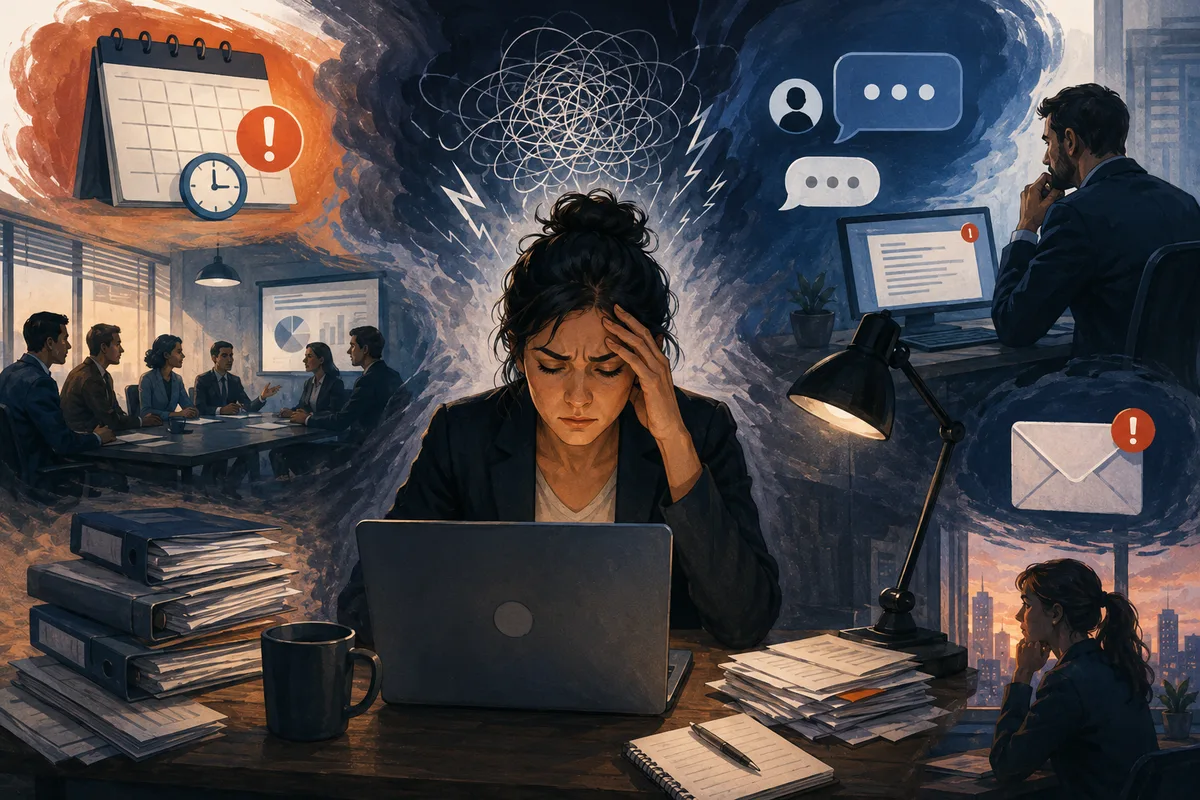
A meeting invite lands with no agenda. Your manager types "can we talk?" in chat. You have to present and your mouth is dry twenty minutes early. Work anxiety is not about being bad at your job. Most people experiencing it are actually over-performing, running constant background processes to monitor how they are being perceived and what might go wrong next. That monitoring costs energy, and by mid-afternoon you are running on fumes. This is not a guide about overhauling your relationship with work. It is about getting through the next meeting, the next email, the next hour.
Why work is a perfect anxiety environment
Work combines several conditions that make anxiety thrive: social evaluation, ambiguous feedback, limited control, and stakes that feel high. Your amygdala cannot distinguish between "a predator is approaching" and "my manager might think I am underperforming." Both register as survival threats. The WHO estimates that depression and anxiety cost the global economy roughly US$1 trillion a year in lost productivity, which gives some sense of the scale.
Most workplaces also reward the exact behaviors anxiety drives. Overworking, over-preparing, constantly checking for mistakes, saying yes to everything - these look like dedication from the outside. From the inside they are safety behaviors: things you do to prevent the feared outcome. And safety behaviors reinforce the anxiety loop. You over-prepare for a presentation, it goes fine, and your brain concludes the over-preparation was necessary rather than excessive.
Cortisol also follows a pattern at work that makes things harder. It peaks in the morning, stays elevated through high-demand tasks, and should taper in the afternoon. If you are anxious, cortisol stays elevated all day. Your body never gets the signal to stand down, so by 5pm you are exhausted but still wired.
The "can we talk?" spiral
Few phrases trigger workplace anxiety faster than "can we talk?" or a calendar invite with no description. The brain immediately fills the blank with the worst case. You are being fired. You made a catastrophic mistake. Someone complained about you.
This is catastrophic prediction. Your amygdala generates the most threatening interpretation and presents it as the most likely one. In ordinary work life, most of these messages turn out to be neutral: scheduling, small process questions, minor clarifications. Your brain is not generating a probability estimate. It is generating a fear.
The micro-reset: notice the physical spike - the chest tightness, the stomach drop, the heat in your face. Name it: "this is the prediction pattern, not information." Take three slow breaths before responding. Not because breathing solves the problem, but because it stops you from responding from the panic state, which usually looks like over-apologizing or frantic message-checking. If you can, ask for context: "Sure - what is it about?" This is not avoidance. It is information-gathering, and it gives your prefrontal cortex something concrete to work with instead of leaving the guessing to your amygdala.
Meeting dread: before, during, after
Before. The anticipatory anxiety is often worse than the meeting. Your brain runs simulations of everything that could go wrong, and each simulation triggers a real stress response. Time-box your preparation: "I will prepare for 15 minutes, then stop." Over-preparation is a safety behavior that teaches your brain the meeting is genuinely dangerous.
During. If anxiety spikes mid-meeting, press your feet firmly into the floor. This activates proprioception - your body's position sense - and pulls attention out of the anxious prediction into the physical present. You can also press your thumb and forefinger together under the table for a small sensory anchor. Nobody notices. These are not relaxation tricks; they are attentional redirects that give your prefrontal cortex a foothold.
After. Anxious brains do a post-mortem. "Did I sound stupid? Did they notice I was nervous? I should have said it differently." This replay is another form of the anxiety loop - it feels like problem-solving but it is rumination. Give yourself a two-minute window: review what happened, note anything genuinely actionable, then close it. If the replay continues past two minutes, that is the pattern, not productive reflection.
Email paralysis and the perfectionism trap
If you have spent 20 minutes drafting a three-sentence email, you know this one. The anxiety is not about the email; it is about being perceived incorrectly. Every word becomes a potential misinterpretation. You re-read it four times, add a softener, delete the softener, add an emoji, delete the emoji.
This is perfectionism functioning as anxiety management. If the email is perfect, it cannot be misread, and if it cannot be misread, you are safe. But perfectionism has diminishing returns. The first draft was probably fine. Everything after is the anxiety talking.
The practical version: set a 3-minute timer per email. Write it, read it once, send it. The discomfort you feel hitting send is not evidence the email is wrong; it is the anxiety losing its safety behavior. Each time you send a "good enough" email and nothing bad happens, the loop weakens.
For genuinely high-stakes emails (a difficult conversation, a request to leadership), write the draft and wait 30 minutes before sending. Not to agonize, but to let the cortisol spike settle. Re-read it once with a calmer nervous system. The original usually needed one small change at most.
Micro-resets between tasks
Work anxiety accumulates. Each stressful interaction adds to baseline, so by mid-afternoon you are reacting to everything as if it is a crisis. Micro-resets interrupt the accumulation before it compounds.
60-second breathing reset. Between meetings, close your eyes and do 4-count inhale, 4-count hold, 6-count exhale. Three rounds. This activates the parasympathetic nervous system and starts lowering the cortisol that has been building. You can do this at your desk with headphones in, or while "reviewing notes" before a call.
Physical discharge. Anxiety creates tension that needs somewhere to go. Walk to the kitchen and back. Stretch your shoulders. Press your palms together hard for 10 seconds and release. These are not wellness fluff - they are completing the stress cycle your body started when the amygdala fired.
Thought externalization. Open a private note and type the anxious thought verbatim. "I think they will realize I do not know what I am doing." Seeing it written out often reveals how distorted it is. You do not need to challenge it or reframe it - just getting it out of working memory and onto a screen takes some of its power.
Work anxiety is not a performance problem. It is a nervous system stuck in monitoring mode, in an environment that rewards monitoring. The goal is not to stop caring; it is to stop running threat-detection on every interaction.
Related pages
Frequently asked questions
Is work anxiety a sign I am in the wrong job? +
Not necessarily. Work anxiety often follows people across jobs because the pattern is internal, not situational. If the anxiety only appears in this specific role and was absent in previous ones, the environment may be a factor. But if you notice the same fears (not good enough, about to be found out, something will go wrong) in every role, it is likely an anxiety pattern that needs addressing regardless of where you work.
Should I tell my manager about my anxiety? +
It depends on your workplace culture and your manager. You do not owe anyone a disclosure. If you choose to share, frame it practically: "I do my best work when I have context for meetings in advance" or "I sometimes need a few minutes to reset between intense calls." You are describing a working style, not asking for special treatment.
Why does work anxiety get worse on Sunday nights? +
Anticipatory anxiety. Your brain runs Monday simulations on Sunday evening - meetings, deadlines, social interactions. The uncertainty triggers the same threat response as the events themselves. A short Sunday wind-down (writing tomorrow's first task, doing a breathing reset) can reduce this by giving the brain concrete information instead of open-ended prediction.
Can work anxiety cause physical symptoms? +
Yes. Chronic workplace stress keeps cortisol elevated, which can cause headaches, stomach issues, muscle tension, fatigue, insomnia, and weakened immunity. If you have recurring headaches or stomach problems that correlate with work stress, the anxiety has reached a level that benefits from real support - not just tactics, but possibly therapy or medical input.
Author
Sebastian Cochinescu · Founder, Anima Felix
Founder of Anima Felix. Writes about everyday anxiety patterns, practical calming tools, and how conversational product design can support people in anxious moments.
Read author profileWhere Anima Felix fits
If work anxiety builds faster than you can reset
The Anima Felix app is built for moments, not marathons - a 60-second breathing reset between meetings, a quick check-in at lunch, or voice support after a hard day.
More from the blog
Can Anxiety Cause Brain Fog?
Worry keeps part of your attention busy in the background, which leaves less for everything else. The fog is real, and anxiety is not its only possible cause.
Body symptomsCan Anxiety Cause Headaches or Migraines?
A tight band of pressure on a stressful day is a familiar way for anxiety to show up in the body. Migraine is a different condition, and a few headache signs need a doctor even when anxiety seems to explain them.
Body symptomsCan Anxiety Cause a Lump in Your Throat?
That stuck feeling has a name, globus sensation, and anxiety is one of its known causes. The quickest clue is whether food and drink still go down normally.