
The 10 Best Anxiety Apps for 2026
An honest look at the top anxiety apps in 2026 - what each one is actually built for, where each one falls short, and how to choose without getting lost in marketing claims.
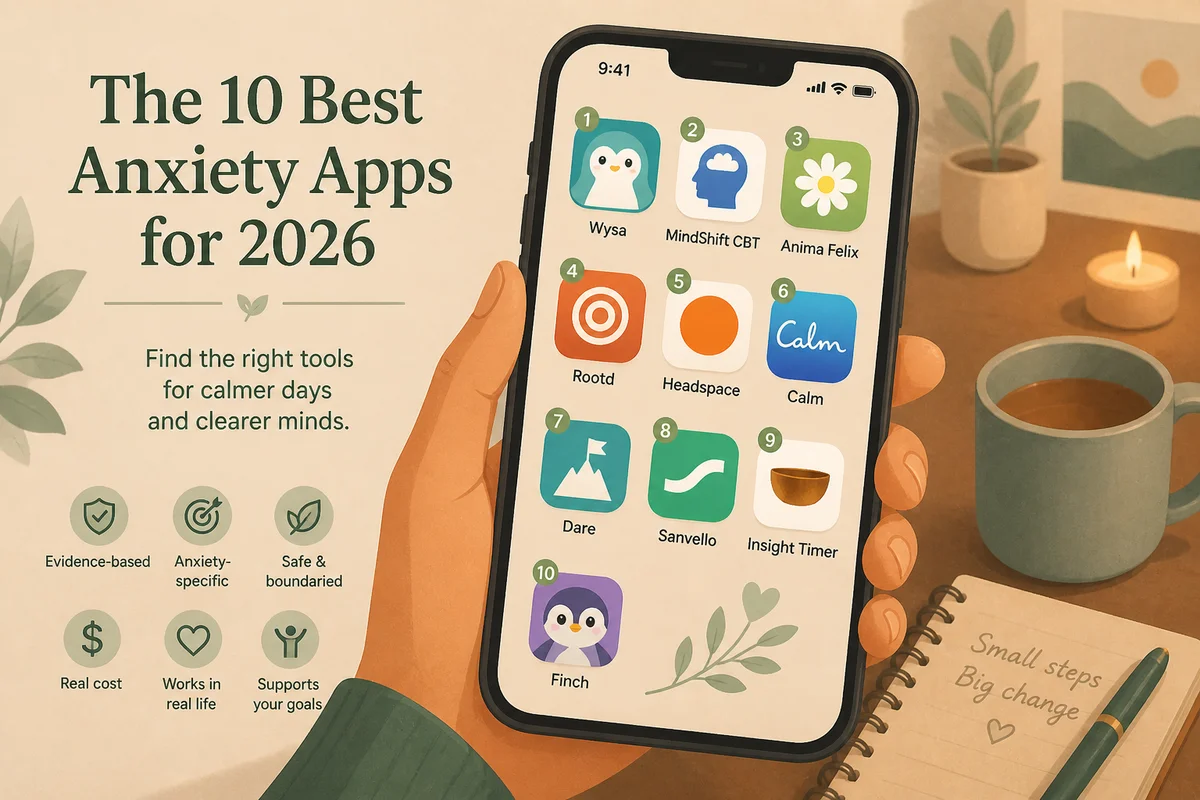
Searching for "best anxiety apps" turns up dozens of ranked lists, most of them written by sites that earn a commission on every download. This one is written by the founder of Anima Felix, an AI anxiety companion that appears at #3 on the list below. That disclosure belongs in the first paragraph, because any "top anxiety apps" article is partly a marketing surface, and the only honest way to write one is to say so up front. What follows is built from clinical evidence where it exists, from how each app is actually designed, and from what specific anxiety problem each one solves better than the others. For the deeper question of whether AI mental-health tools are safe at all, see the longer piece on trusting AI with your mental health.
How this list was put together
Most "best app" lists are sorted by App Store rating or by how much an app pays out in affiliate commissions. Both metrics are weak signals for whether the app will actually help with anxiety.
This list weighs four things instead:
Evidence. Peer-reviewed studies, FDA recognition where it applies, or a clearly stated scientific framework like CBT, ACT, or exposure therapy.
Anxiety specificity. Tools built specifically for anxiety, versus general wellness apps that include anxiety as one topic among many.
Safety design. Bounded interactions with natural endpoints, clear scope, transparent statements about what the app is not, and crisis routing when the situation calls for more than software can handle.
Real cost. Subscription pricing, free tier quality, and whether the core anxiety features are paywalled.
The list deliberately mixes mainstream meditation apps, anxiety-specific tools, panic-attack apps, AI companions, and tracking apps - because real anxiety rarely fits one category. Most people end up using two or three of these together rather than picking just one.
1. Wysa - Best AI emotional support with clinical backing
Wysa is an AI chatbot guided by CBT and DBT principles, with a free core that includes thought reframing, breathing exercises, and mood tracking. Its biggest strength is the breadth of evidence behind it: peer-reviewed research, an FDA "Breakthrough Device" designation for chronic-pain-related anxiety and depression, and an optional paid tier that adds access to human therapists.
Where it works best. People who want always-available, structured support in conversational form - especially between therapy sessions or when professional care is hard to access on short notice.
Where to be careful. Like any AI chat tool, Wysa works best as a complement to real-world support, not as a replacement. The longer post on trusting AI with your mental health covers the broader design questions; the direct comparison with Anima Felix covers the specific differences in how each app handles boundaries and scope.
2. MindShift CBT - Best free anxiety-specific CBT app
MindShift is built and maintained by Anxiety Canada, a non-profit. It is fully free, with no paywalls or upsells, and is one of the few apps designed specifically for anxiety rather than general wellness. The tools follow standard CBT protocol: thought records, identification of "thinking traps" like catastrophizing and mind reading, fear ladders for graded exposure, and structured worry exercises.
Where it works best. People who want CBT structure without the cost - students, people without insurance, anyone who responds well to a workbook-style approach. It is also a strong starting point if a therapist has recommended CBT and you want to practice between sessions.
Where to be careful. The app is functional rather than flashy. The interface feels closer to a clinical tool than a polished wellness product. If you need engagement design and gentle nudges to keep coming back, MindShift can feel dry. Use it for the structure, not the experience.
3. Anima Felix - Best for short, structured anxiety moments
Anima Felix is an anxiety-first AI companion built around short, structured moments rather than open-ended conversation: guided breathing, 5-4-3-2-1 grounding, body relaxation, Stress Jenga, and a quick anxiety check. Optional voice support exists as an entry point into those exercises, not as a destination in itself. The app is explicit that it is not therapy, not a crisis service, and routes to professional help when a situation needs more than software can handle.
Where it works best. People whose anxiety shows up as discrete moments - a 3am spiral, a panic surge, a tight-chest commute, an overthinking loop before bed - and who want a tool that helps them regulate and put the phone back down rather than keep talking.
Where to be careful. If you want a chatbot you can talk to for hours, Anima Felix is deliberately not that. See how Anima Felix helps for the design rationale, or compare it directly with Wysa, Calm, and Rootd.
4. Rootd - Best for panic attacks
Rootd is the standout app for acute panic. Its signature feature is a large, prominent "panic button" on the home screen that launches an immediate guided intervention - grounding, breathing, and a steady voice walking you through what is happening in your body. The app also includes panic education, a mood and panic-attack journal, and basic tracking tools.
Where it works best. People whose anxiety pattern includes recurring panic attacks and who need a tool they can open with one hand, with no scrolling, in the middle of an attack. The post on grounding exercises for panic attacks covers the underlying technique most panic apps use.
Where to be careful. Rootd is excellent at the panic moment but lighter on the broader anxiety toolkit - structured CBT, daily routines, sleep, longer-term management. If you want a single app that covers both the acute moment and the day-to-day, you will likely pair it with something else. The direct comparison with Anima Felix goes into more detail.
5. Headspace - Best mainstream meditation app for anxiety
Headspace is the most polished mainstream meditation product on the market. Its anxiety-related content includes guided meditations, breathwork, sleep tools, and CBT-influenced exercises, organised into structured curricula. The 2026 addition of an AI companion called "Ebb" makes the experience feel more personalised - Ebb checks in, adapts recommendations, and softens the "what should I do now" friction many users hit with meditation apps.
Where it works best. People who want to build a daily mindfulness habit and who appreciate a curated, narrative-driven experience. Headspace is also strong if you respond well to a single consistent voice and structured progress.
Where to be careful. Headspace is a meditation app first; anxiety is one topic among many. If your anxiety needs in-the-moment intervention rather than a long-term habit, a more specialised tool will likely be a better fit. Its AI companion Ebb is bounded by the wider Headspace product, but it is still worth applying the same scrutiny any AI mental-health tool deserves.
6. Calm - Best for sleep anxiety and rumination
Calm built its reputation on Sleep Stories - bedtime narratives read by celebrities like Matthew McConaughey, Stephen Fry, and Harry Styles - and that is still where it shines. The app also includes meditations, breathwork, soundscapes, and daily calming programmes. It is the best mainstream option for people whose anxiety is closely tied to sleep.
Where it works best. People who lie awake ruminating, whose worst anxiety windows are at night, and who do well with audio-led calming routines. The post on why anxiety gets worse at night covers the underlying mechanism and explains why audio-led wind-down works.
Where to be careful. Like Headspace, Calm is a wellness platform rather than an anxiety-specific tool. Most of the content is meditation and sleep - there is less for someone in the middle of a daytime anxiety spike or a panic episode. The side-by-side with Anima Felix breaks down the difference between general wellness and anxiety-specific design.
7. Dare - Best exposure-based approach for panic and intrusive thoughts
Dare is built around Dr. Barry McDonagh's anxiety-recovery method, which inverts the usual instinct: instead of fighting or distracting yourself from anxious feelings, the Dare approach has you turn toward them and let them pass through. The app includes audio-guided exercises for panic, intrusive thoughts, insomnia, driving anxiety, flying anxiety, and an SOS feature for acute moments.
Where it works best. People whose anxiety has a strong avoidance component, who have tried "calming down" approaches without lasting improvement, and who are open to a counter-intuitive method that has a strong track record in panic-disorder treatment.
Where to be careful. The approach is powerful but takes practice. It can initially feel uncomfortable to "lean into" anxiety rather than away from it. People in acute crisis or with active trauma should pair this with professional support - exposure work without a therapist can backfire when the underlying load is too high.
8. Sanvello - Best mood tracking with CBT structure
Sanvello combines daily mood tracking, guided CBT journeys, coping tools, and a peer community in one clinically validated app. It is also one of the few mental-health apps covered by many U.S. insurance plans, which can make the paid tier free for users with eligible coverage.
Where it works best. People who want a structured progression - mood logging that feeds into pattern recognition that feeds into targeted CBT exercises - and who are in the U.S. with insurance that covers it.
Where to be careful. Sanvello has shifted ownership and product focus several times (it now sits inside AbleTo's SelfCare+ offering), and feature availability and free-tier limits have moved with each shift. Check current availability and pricing in your region before committing to it as your primary tool.
9. Insight Timer - Best free meditation library
Insight Timer is the largest free meditation library on the market, with tens of thousands of guided meditations across teachers, traditions, and topics. The free tier is unusually generous: it includes most of the library, customisable timers, and group meditation rooms. The New York Times Wirecutter named it the overall best meditation app in 2026.
Where it works best. People who want variety and choice, who do not want a single voice or style, and who prefer a free product to a subscription. It is also strong if you have a specific tradition or technique in mind - there are usually multiple teachers offering it.
Where to be careful. The sheer volume can be overwhelming if you do not know what you are looking for. The app is also primarily meditation-focused; anxiety-specific content is a subset of a much larger library, and you will need to navigate to find it.
10. Finch - Best gentle daily self-care app
Finch turns daily self-care into a low-pressure pet game: a virtual bird grows as you complete goals, journal, check in with your mood, or do small breathing exercises. The design is deliberately therapeutic - there are no broken streaks, no punishment for missed days, no shame loops.
Where it works best. People who have tried "serious" mental-health apps and bounced off them, who are prone to shame from broken streaks, and who do better with a gentle, gamified entry point.
Where to be careful. Finch is supportive but not deep. If your anxiety is severe enough to interfere with daily functioning, treat it as a complement to other tools - or to therapy - rather than as a primary intervention. It is best paired with one of the structured options higher on this list.
Honourable mentions
A few apps that almost made the top 10 and are worth knowing about:
Daylio. Excellent for tracking mood and behaviour patterns over time, especially alongside therapy. Less prescriptive than the apps above; mostly a clean, fast logging tool with a powerful pattern view.
Breathwrk. Focused entirely on guided breathing, with a library of techniques for calm, focus, sleep, and stress spikes. Strong choice if breathwork is your main interest and you do not need anything else bundled with it.
Medito. Free, ad-free, non-profit meditation app with a generous library and an anxiety SOS section. The closest thing to Insight Timer on the values side.
Talkspace. Not a self-help app; a teletherapy platform connecting you to licensed therapists. Worth knowing about when self-guided tools are not enough and in-person therapy is hard to access for cost or scheduling reasons.
The best mental health apps overall (and which are free)
Although this is an anxiety-app roundup, several entries also belong on a broader list of the best mental health apps. Headspace and Calm cover meditation, sleep, stress, and everyday mental wellness, while Wysa spans emotional support and structured self-help beyond anxiety. That broader scope can be useful if anxiety is only one part of what you want to work on.
For genuinely free options, MindShift CBT and Medito are fully free. Wysa and Insight Timer offer real free tiers, while other apps may be free to start but reserve some features for paid plans. AFK, Anima Felix's peer-support app, is free with no premium tier: you can post anonymous asks and receive replies from real people, not AI, on iOS and Android.
This review is written by the founder of Anima Felix, so I am not pretending these products are interchangeable or that I have no point of view. The useful question is what kind of support you need: meditation and general wellness, peer support, structured CBT, or a tool for a specific anxiety moment. The comparison hub lays out those differences directly.
How to pick
The most useful framing is not "what is the best app overall" but "what shape is my anxiety, and what tool fits that shape?"
Acute panic that comes out of nowhere. Rootd, Anima Felix, or Dare for the in-the-moment intervention. The post on how to calm down during a panic attack covers what to actually do once you have the app open.
Sleep anxiety and nighttime rumination. Calm or Headspace for the sleep content; Anima Felix for structured wind-down moments; the 3am overthinking guide for the underlying pattern.
Generalised worry that runs all day. MindShift CBT or Sanvello for the structured CBT, plus a meditation app for the daily habit.
You want to talk it out. Wysa for AI chat with a clinical backbone; consider therapy or Talkspace if you want genuine conversational depth that an AI cannot provide.
You want gentle daily support, low pressure. Finch or Insight Timer.
Most people end up using two or three of these together: one for the acute moment, one for the daily habit, and sometimes a tracker to spot patterns. The best app is the one you will actually open when the wave hits, not the one with the most features.
When apps are not enough
Apps work best for mild-to-moderate anxiety and as a supplement to other support. If anxiety is significantly affecting your work, relationships, sleep, or basic functioning - or if it includes panic attacks happening often, intrusive suicidal thoughts, or a sense that something is fundamentally wrong - talking to a clinician is the higher-leverage step.
If you are in crisis, contact your local emergency services. In the U.S., the 988 Suicide and Crisis Lifeline is free and confidential. In the U.K., Samaritans is reachable on 116 123. International helplines are listed on findahelpline.com.
The anxiety help guide covers how to think about the different levels of support - apps, peer support, therapy, medication - and when to escalate. No app on this list, including Anima Felix, is designed to be the only thing you reach for when the load is more than software should handle.
There is no app that solves anxiety. Apps reduce friction around the small repeatable practices that lower a baseline. The best one is the one you will actually open when the wave hits.
Related pages
Frequently asked questions
What is the best anxiety app overall? +
There is no single "best" anxiety app, because the best app depends on the shape of your anxiety. For panic attacks, Rootd is the strongest pick. For free CBT, MindShift CBT. For sleep anxiety, Calm. For AI chat support with clinical backing, Wysa. For short structured anxiety moments and a clear "use it then put it down" design, Anima Felix. Most people end up using two or three together.
Are anxiety apps actually effective? +
For mild-to-moderate anxiety, yes - especially apps grounded in CBT, mindfulness, or exposure therapy, and especially when used consistently. Multiple peer-reviewed studies have shown that app-based CBT and mindfulness can produce meaningful reductions in anxiety symptoms. The catch is that effects are typically modest and depend on regular use; an app you download and never open will not help. Apps work best as a supplement to professional care, not as a replacement.
Can I use an anxiety app instead of therapy? +
For mild anxiety, an app may be enough on its own. For moderate anxiety, apps are useful but rarely sufficient. For severe anxiety - the kind that interferes with work, relationships, sleep, or basic functioning - therapy is the higher-leverage step, and an app is best used to support what happens between sessions. None of the apps on this list, including Anima Felix, is built to replace a clinician.
What is the best free anxiety app? +
MindShift CBT is the strongest fully free option for anxiety specifically. Insight Timer is the strongest free option for meditation, with anxiety-relevant content as a subset of its larger library. Medito is also fully free and non-profit. Wysa offers a generous free tier for its core CBT and DBT exercises, with paid options for human therapist access.
What is the best free mental health app? +
There is no single best free mental health app for every need. MindShift CBT and Medito are fully free options for structured anxiety support and meditation respectively, while Insight Timer and Wysa have real free tiers. For anonymous peer support, <a href="/afk/">AFK</a> is free with no premium tier and its replies come from real people, not AI. The right choice depends on whether you want exercises, meditation, conversation, or peer support.
What is the difference between a mental health app and an anxiety app? +
A mental health app usually covers a wider range of needs, such as stress, sleep, mood, meditation, or emotional support. An anxiety app is narrower: its tools and guidance are designed around worry, panic, physical anxiety symptoms, or anxious thought patterns. The categories overlap, which is why Headspace, Calm, and Wysa can fit a broader mental wellness list while also offering useful anxiety support.
What is the best app for panic attacks? +
Rootd is purpose-built for panic, with a one-tap "panic button" that launches an immediate guided intervention. Anima Felix and Dare are also strong for the panic moment - Dare with its lean-in approach, Anima Felix with structured grounding and breathing flows. Pick whichever interface you can actually navigate when an attack is starting; the post on grounding exercises for panic attacks goes deeper into the technique most of these apps use.
Is Anima Felix free? +
Anima Felix has a free tier that includes core anxiety check-ins and some exercises, with optional paid features. The download page covers current pricing and platform availability. As with every app on this list, the more important question is whether the free tier alone gives you what you need - and that depends on the shape of your anxiety.
Author
Sebastian Cochinescu · Founder, Anima Felix
Founder of Anima Felix. Writes about everyday anxiety patterns, practical calming tools, and how conversational product design can support people in anxious moments.
Read author profileWhere Anima Felix fits
If you want an anxiety-first companion built for short, structured moments
Anima Felix gives you bounded exercises - breathing, grounding, body relaxation, Stress Jenga - with clear endpoints. Chat and voice are entry points into those, not open-ended conversations.
More from the blog
Anxiety Attack vs Panic Attack: What Is the Difference?
Only one of these two phrases is a clinical term. Knowing which is which explains why two people can describe an anxiety attack and mean completely different experiences.
Body symptomsCan Anxiety Cause Diarrhea and Sudden Bathroom Urgency?
Anxiety can change how your gut behaves. The harder problem is usually the loop that forms afterwards, when every trip out starts getting planned around bathrooms.
Mind and bodyCan Nicotine or Vaping Make Anxiety and Panic Worse?
Nicotine feels like it takes the edge off. What it mostly takes off is the edge nicotine put there in the first place.