
Why Do I Feel Anxious for No Reason?
No tiger. No deadline. No argument. Just a hum of dread that showed up uninvited. The anxiety has a reason - it just does not have an obvious trigger.
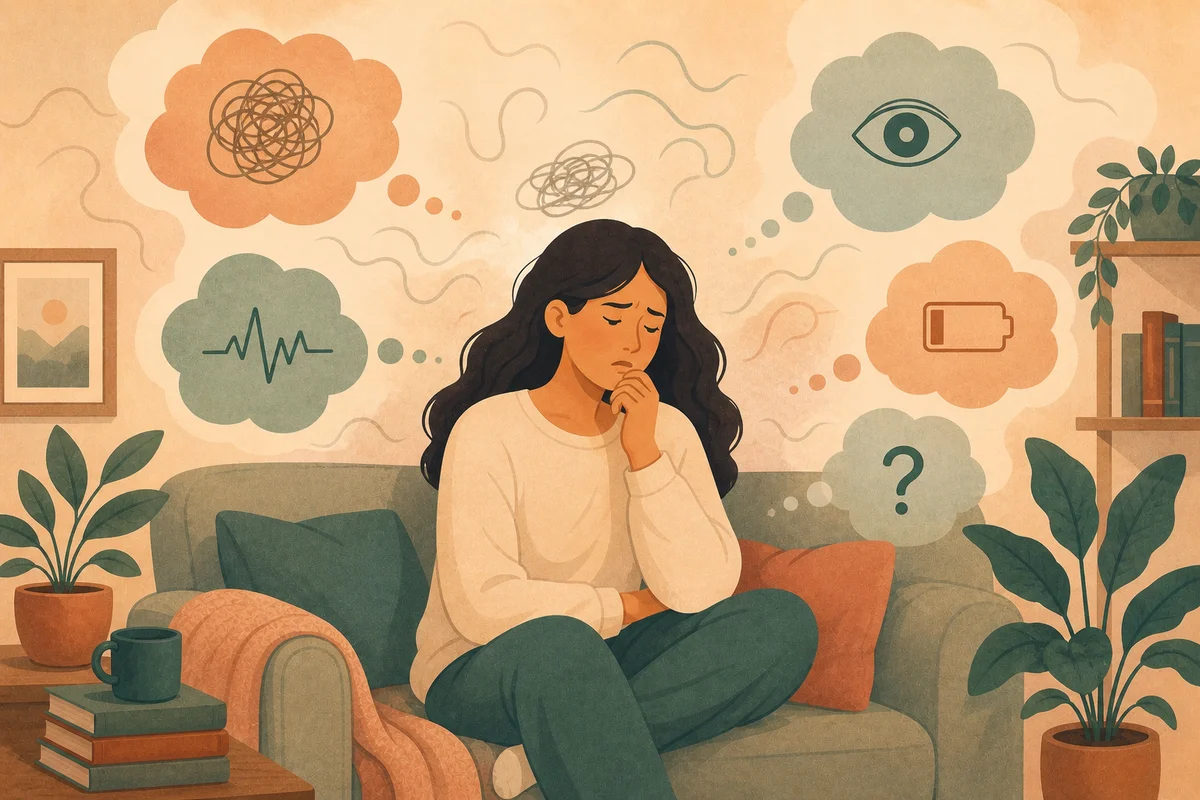
You are sitting on the couch. Nothing is wrong. Nobody is angry. No deadline is looming. And yet your chest is tight, your mind is scanning for threats, and there is a low-grade sense that something bad is about to happen. You cannot point to it. You cannot name it. You just feel anxious. This kind of free-floating anxiety is one of the most disorienting versions of the experience, because the absence of an obvious trigger makes the whole thing feel irrational. It usually is not. The causes are real - they are just distributed across stress load, body tension, and things you have been pushing aside.
Your nervous system has a thermostat
Your autonomic nervous system regulates your baseline arousal level - think of it as a thermostat that determines how activated or calm your body is at rest. In a well-regulated system, the thermostat sits somewhere comfortable: alert enough to function, calm enough to rest.
But the thermostat can get stuck at a higher setting. Chronic stress, poor sleep, unresolved emotional experiences, or long periods of being "on" can gradually push your baseline arousal upward. You do not notice the shift because it happens slowly - over weeks or months, your body adjusts to the new normal.
The result is that your resting state is now closer to fight-or-flight than it should be. You are not anxious about anything specific because the anxiety is not triggered by a specific thought. It is your baseline. Your nervous system is running hot, and the free-floating dread you feel is the subjective experience of a dysregulated thermostat.
This is why "no reason" anxiety often puzzles people who have objectively good lives. The anxiety is not about your circumstances. It is about the accumulated load on your nervous system.
Accumulated stress: the container metaphor
Think of your stress tolerance as a container. Every stressor - work pressure, relationship friction, financial worry, poor sleep, too much caffeine, a news cycle that will not quit - adds volume to the container. Small stressors add small amounts. You do not notice each one individually.
But the container has a fixed capacity. Once it is full, any additional input - even a tiny one - causes overflow. The overflow is the anxiety that seems to come from nowhere. You did not have a single triggering event. You had fifty small ones that filled the container past its threshold.
This explains why the anxiety can appear on a random Tuesday when nothing specific happened. Nothing new went in - but the container was already near full, and the small bump from a bad night of sleep or an awkward interaction was enough to tip it over.
It also explains why the anxiety sometimes lifts after something as minor as a good night of sleep or a canceled obligation. You did not solve the anxiety. You drained a little volume from the container and dropped back below the threshold.
The implication is uncomfortable but useful: "no reason" anxiety is often a signal that your overall stress load is too high, even if no single stressor seems significant enough to cause this reaction.
Avoidance debt: the things you are not thinking about
There is another source of "no reason" anxiety that is harder to spot: avoidance debt. This is the accumulated cost of things you have been pushing aside, not dealing with, or actively avoiding.
The email you have not replied to for two weeks. The conversation you need to have but keep postponing. The medical appointment you should schedule. The financial situation you have not looked at closely. The friendship that has shifted and you do not want to examine why.
Each avoided item gets suppressed from conscious awareness, but it does not disappear. Your brain is still tracking it in the background, allocating low-level processing power to keep it managed. This background processing creates what psychologists call cognitive load - your mental bandwidth is being used even when you are not actively thinking about the avoided items.
The anxiety you feel "for no reason" may actually be the aggregate emotional signal from all the things you are successfully not thinking about. Your conscious mind does not know what is wrong. But the part of your brain that tracks unfinished business knows exactly what is wrong - it just cannot tell you in words.
A practical test: sit down and list everything you have been avoiding or postponing. Do not solve them - just list them. Many people find that the act of making the list temporarily reduces the free-floating anxiety, because you have moved the items from background processing into conscious awareness where they feel more manageable.
Tension your body has been holding in the background
Bodies store unprocessed stress in muscle tension patterns that can generate anxiety symptoms with no psychological trigger attached. Chronic stress leads to sustained low-level contraction in the jaw, shoulders, chest, and abdomen. Those patterns can persist long after the original stressor is gone, because the muscles have adapted to the contracted state.
Chest tension produces a feeling of tightness and shallow breathing. Jaw clenching creates headaches and pressure. Shoulder tension feels like bracing, as if you are waiting for an impact. Abdominal tension produces the classic "knot in my stomach" sensation.
Your brain then reads those sensations as evidence of threat. It does not know the tight chest comes from months of hunching over a laptop in a stressful job; it just registers "chest tight, breathing shallow" and treats it as a signal. Because the physical cause is chronic and largely invisible, the resulting anxiety can feel like it appeared from nowhere.
This is why body-focused approaches (progressive muscle relaxation, body scans, regular physical exercise) often shift "no reason" anxiety more reliably than trying to reason with it. If the anxiety is living in your body, that is where the intervention has to land.
What to do when anxiety has no obvious cause
Do not search for the cause. The instinct when you feel anxious "for no reason" is to scan your life for what is wrong. This usually fails - either you cannot find anything (which makes the anxiety scarier) or you attach the anxiety to something that is not actually the source (which creates a new worry loop). The anxiety does not need a narrative to be addressed.
Address the body first. Slow breathing helps the parasympathetic nervous system come back online. A body scan shows where you are holding tension. Gentle movement (walking, stretching) burns off some of the adrenaline and cortisol that may be sustaining the arousal state. These work on the same mechanism that is producing the anxiety, which is why they tend to do more than self-talk in the moment.
Audit your stress container. Look at sleep, caffeine, screen time, work hours, relationship friction, and the news you are consuming. You do not need to find a single cause. You need to reduce the total volume. Often, improving sleep alone is enough to drop below the anxiety threshold.
Process the avoidance debt. Pick one avoided item - the smallest one - and deal with it. Send the email. Schedule the appointment. Have the conversation. Each resolved item frees up background processing capacity and reduces the load that was generating the free-floating signal.
Track the pattern. When the "no reason" anxiety appears, note the time of day, what you ate, how you slept, what happened in the previous 24 hours. Over a few weeks, patterns emerge that are invisible in the moment. Anima Felix's quick anxiety check is designed for exactly this kind of tracking - naming the experience when it is happening so you can see the pattern over time.
Free-floating anxiety usually has causes - they are just spread across stress load, body tension, and avoided tasks rather than concentrated in one obvious trigger. The work is reducing the total volume, not finding a single villain.
Related pages
Frequently asked questions
Is feeling anxious for no reason a sign of a disorder? +
Not necessarily. Everyone experiences free-floating anxiety occasionally, especially during periods of high accumulated stress. If it happens frequently (most days for several weeks), significantly impacts your daily functioning, or does not respond to self-management strategies, it is worth discussing with a healthcare professional. Generalized anxiety disorder (GAD) is characterized by persistent, excessive worry that is difficult to control.
Can physical health cause anxiety with no obvious trigger? +
Yes. Thyroid imbalances (especially hyperthyroidism), blood sugar instability, hormonal changes, certain medications, excessive caffeine, and some vitamin deficiencies can produce anxiety symptoms without a psychological trigger. If free-floating anxiety is new or sudden, a basic medical check is worth pursuing.
Why does my anxiety get worse when I try to relax? +
This is sometimes called relaxation-induced anxiety, and it can happen because your nervous system has adapted to a high-arousal baseline. When you try to slow down, the shift can feel unfamiliar - your brain may interpret the new calm as a loss of vigilance. The solution is gradual downregulation rather than sudden relaxation: gentle breathing or a slow walk rather than meditation if meditation tends to make the anxiety spike.
Does anxiety for no reason go away on its own? +
It can, if the underlying causes resolve - a stressful period ends, sleep improves, avoidance debt gets addressed. But if the pattern is chronic, waiting it out usually means the nervous system stays elevated. Active steps like stress reduction, body-focused practices, and processing avoided issues tend to help more reliably than passive waiting.
Author
Sebastian Cochinescu · Founder, Anima Felix
Founder of Anima Felix. Writes about everyday anxiety patterns, practical calming tools, and how conversational product design can support people in anxious moments.
Read author profileWhere Anima Felix fits
If the anxiety keeps showing up without a reason to point to
Anima Felix helps you name and track what is happening even when you cannot explain it. The quick check-in captures the pattern, the exercises address the body, and the companion helps you process what might be underneath.
More from the blog
Anxiety Attack vs Panic Attack: What Is the Difference?
Only one of these two phrases is a clinical term. Knowing which is which explains why two people can describe an anxiety attack and mean completely different experiences.
Body symptomsCan Anxiety Cause Diarrhea and Sudden Bathroom Urgency?
Anxiety can change how your gut behaves. The harder problem is usually the loop that forms afterwards, when every trip out starts getting planned around bathrooms.
Mind and bodyCan Nicotine or Vaping Make Anxiety and Panic Worse?
Nicotine feels like it takes the edge off. What it mostly takes off is the edge nicotine put there in the first place.