
What Does Anxiety Feel Like in the Body?
Anxiety is not just racing thoughts. It is the tight chest, the knot in your stomach, the exhaustion sleep does not fix. Here is what is happening in your body.
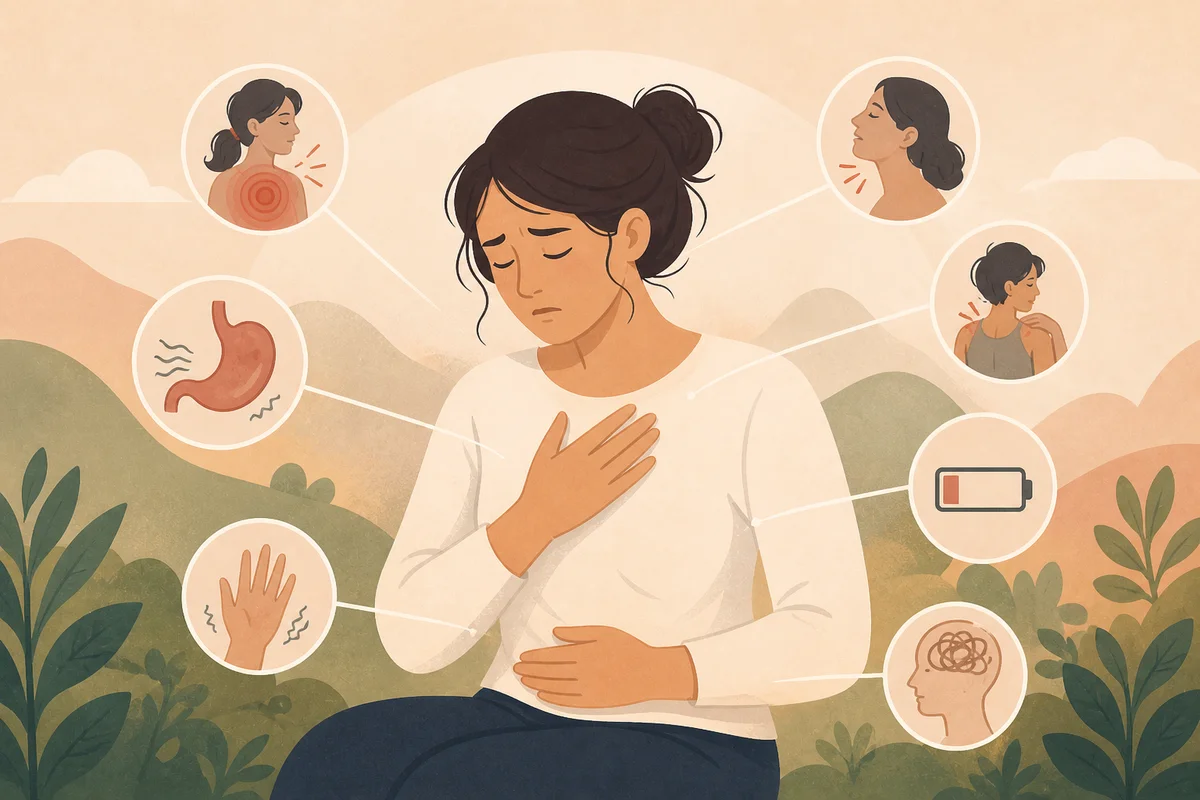
Most people picture anxiety as a mental experience: racing thoughts, worst-case scenarios, the voice that says "what if." For a lot of people it actually shows up in the body first. The tight chest that will not ease. The stomach that churns before every meeting. The exhaustion that sleep does not fully fix. The tingling in your hands when nothing is physically wrong. The body symptoms are part of the anxiety - the same nervous-system response, just expressed below the neck. Knowing how that connection works changes how you respond when the symptoms appear.
Why anxiety lives in the body
Your brain does not always make a clean distinction between a physical threat and an imagined one. When you think about something stressful - a difficult conversation, a financial worry, an uncertain future - your brain can activate the same survival system it would use if you were facing physical danger. This is the fight-or-flight response, managed primarily by the sympathetic nervous system.
When fight-or-flight activates, it triggers a cascade of physical changes designed to help you survive a threat. Your heart rate increases to pump more blood to your muscles. Your breathing quickens to take in more oxygen. Your digestion slows down because running from danger is more important than processing lunch. Your muscles tense up, ready to fight or flee. Stress hormones like cortisol and adrenaline flood your system.
The problem is that modern anxiety rarely involves an actual physical threat. The meeting, the text you are waiting for, the worry about the future - none of these require you to run. But your body prepares to run anyway. And when you do not actually run, the physical activation has nowhere to go. It often sits in your body as symptoms: chest pressure, stomach problems, muscle tension, fatigue.
The most common physical symptoms of anxiety
Chest tightness and heart pounding are among the most frightening symptoms because they can mimic cardiac problems. Anxiety increases heart rate and can cause the chest muscles to tighten, creating a sensation of pressure or constriction. Many people end up in emergency rooms convinced they are having a heart attack, only to be told it is anxiety. This is not imaginary - the sensations are real. They are just being driven by your nervous system, not your heart.
Stomach problems - nausea, churning, loss of appetite, or digestive symptoms - happen because the gut and brain are directly connected through the vagus nerve. When your brain senses a threat, it can signal the gut to pause digestion and redirect energy. This is why anxiety often hits your stomach first, and why chronic anxiety can contribute to long-term digestive issues.
Muscle tension, especially in the jaw, shoulders, and neck, is so common in anxious people that many do not even realize they are doing it. You clench your jaw without noticing. Your shoulders creep up toward your ears. Your hands grip things tighter than necessary. Over time, this constant low-level tension can lead to headaches, back pain, and a feeling of physical exhaustion even on days you have not done anything physically demanding.
Fatigue is the symptom that confuses people the most. "I slept eight hours - why am I so tired?" Because your nervous system has been running in high-alert mode, burning through energy even while you sleep. Anxiety-driven fatigue is not the same as regular tiredness. It can be a depletion that rest alone does not fully fix because the underlying activation is still running.
Other common symptoms include tingling or numbness in hands and feet (often linked to changes in breathing pattern), dizziness (from shallow breathing and tension), feeling a lump in the throat (globus sensation, triggered by throat muscle tension), and temperature changes like sudden chills or waves of heat.
The symptom-anxiety cycle
Here is where things get tricky. Physical symptoms of anxiety can themselves become a source of anxiety. You notice your heart racing, and you think: "Why is my heart racing? Is something wrong?" That thought triggers more anxiety, which can increase the heart rate further, which creates more worry. This is the symptom-anxiety cycle, and it is one of the most common ways anxiety escalates.
Health anxiety is often built largely on this cycle. A normal body sensation (a muscle twitch, a headache, a skipped heartbeat) gets noticed, interpreted as dangerous, and then monitored obsessively. The monitoring increases body awareness, which means you notice more sensations, which creates more worry.
None of this is a character flaw. The brain is doing what brains do - scanning for threats and trying to keep you safe. The trouble starts when the "threat" is a normal body sensation, and the protection system itself becomes the problem.
Breaking the cycle does not require you to stop noticing symptoms. It requires you to change your response when you notice them. Instead of "What is wrong with me?" try "My nervous system is activated. This is uncomfortable but, if it has been medically cleared, not dangerous."
What actually helps with physical anxiety
Start with the body, not the thoughts. When anxiety is primarily physical, trying to think your way out of it rarely works. Instead, directly target the physical activation.
Breathing exercises are one of the fastest ways to shift your nervous system from fight-or-flight (sympathetic activation) toward rest-and-digest (parasympathetic activation). Slow, controlled breathing - especially with a longer exhale than inhale - signals your brain that you are safe. Even 60 seconds of deliberate breathing can change how your body feels.
Body relaxation techniques like progressive muscle relaxation work by deliberately tensing and then releasing muscle groups. This is counterintuitive - you are adding tension to already-tense muscles - but the release phase often creates a deeper relaxation than simply trying to relax. It also builds awareness of where you hold tension, which helps you catch it earlier.
Movement helps because it can complete the stress cycle. Your body prepared to fight or flee, so giving it some physical outlet (a walk, stretching, even shaking your hands out) allows the activation to discharge naturally instead of sitting in your muscles as chronic tension.
Grounding techniques like the 5-4-3-2-1 exercise pull your attention out of the body-scanning loop and into present-moment sensory awareness. This gives your brain something concrete to process instead of running threat assessments on every sensation.
When to talk to a doctor
Physical symptoms of anxiety overlap with many medical conditions, and it is important not to dismiss everything as "just anxiety" without checking. If you are experiencing new or severe symptoms - especially chest pain, significant breathing difficulty, or sudden numbness - see a doctor to rule out other causes.
Once medical causes are excluded, an "anxiety" diagnosis is good news in a practical sense: the symptoms are treatable, manageable, and tend to respond to the right tools. The sensations are real - they are produced by a real internal signal - and the goal is to change that signal rather than ignore the body.
If physical anxiety is constant and significantly affecting your daily life - if you cannot eat, cannot sleep, cannot function at work because of the symptoms - a combination of professional support and daily management tools is often the most effective approach. An app like Anima Felix can help with the daily management piece: regular breathing practice, body relaxation, and a place to check in with how your body is feeling before the symptoms escalate.
Anxiety symptoms in the body are downstream of a nervous-system signal, not evidence that something has gone wrong with the body itself. Quiet the signal - usually through breath and movement - and the symptoms tend to follow.
Related pages
Frequently asked questions
Can anxiety cause real physical pain? +
Yes. Anxiety causes real muscle tension, digestive changes, and nervous system activation that can produce genuine physical pain. Tension headaches, stomach cramps, chest tightness, and back pain from chronic muscle clenching are all common. The pain is not imaginary - the cause is anxiety rather than a structural injury, but the sensation is real.
How do I know if my chest tightness is anxiety or a heart problem? +
Anxiety-related chest tightness typically comes with other anxiety symptoms (racing thoughts, shallow breathing, general nervousness), often shifts location slightly, and tends to improve with slow breathing. Cardiac chest pain is usually accompanied by pressure radiating to the arm or jaw, shortness of breath unrelated to anxiety, or dizziness. If you are unsure, always get checked by a doctor first. Once cardiac causes are ruled out, you can address the anxiety component with confidence.
Why does anxiety make me so exhausted even when I have not done anything? +
Your nervous system has been running in survival mode, which burns significant energy. Cortisol and adrenaline keep your body on alert, your muscles stay semi-tensed, and your brain runs at high speed scanning for threats. This is physically draining even if you are sitting still. The exhaustion often improves as you learn to regulate the nervous system activation throughout the day rather than letting it run continuously.
Can physical anxiety symptoms become permanent? +
Chronic anxiety can lead to long-term patterns like persistent muscle tension, digestive sensitivity, or sleep disruption. But these patterns are usually reversible with consistent practice. They developed over time, and they tend to resolve over time. Regular breathing exercises, body relaxation, movement, and (when needed) professional support gradually retrain the nervous system to stop running in high-alert mode by default.
Author
Sebastian Cochinescu · Founder, Anima Felix
Founder of Anima Felix. Writes about everyday anxiety patterns, practical calming tools, and how conversational product design can support people in anxious moments.
Read author profileWhere Anima Felix fits
If anxiety keeps showing up in your body first
Anima Felix includes breathing and body relaxation exercises designed to engage the nervous system directly - often the fastest path from a tight chest or knotted stomach back toward calm.
More from the blog
Anxiety Attack vs Panic Attack: What Is the Difference?
Only one of these two phrases is a clinical term. Knowing which is which explains why two people can describe an anxiety attack and mean completely different experiences.
Body symptomsCan Anxiety Cause Diarrhea and Sudden Bathroom Urgency?
Anxiety can change how your gut behaves. The harder problem is usually the loop that forms afterwards, when every trip out starts getting planned around bathrooms.
Mind and bodyCan Nicotine or Vaping Make Anxiety and Panic Worse?
Nicotine feels like it takes the edge off. What it mostly takes off is the edge nicotine put there in the first place.