
What Happens in Your Brain During a Panic Attack
A panic attack feels like dying. It is not. It is your brain running an emergency protocol for a threat that is not there. Here is the full sequence.
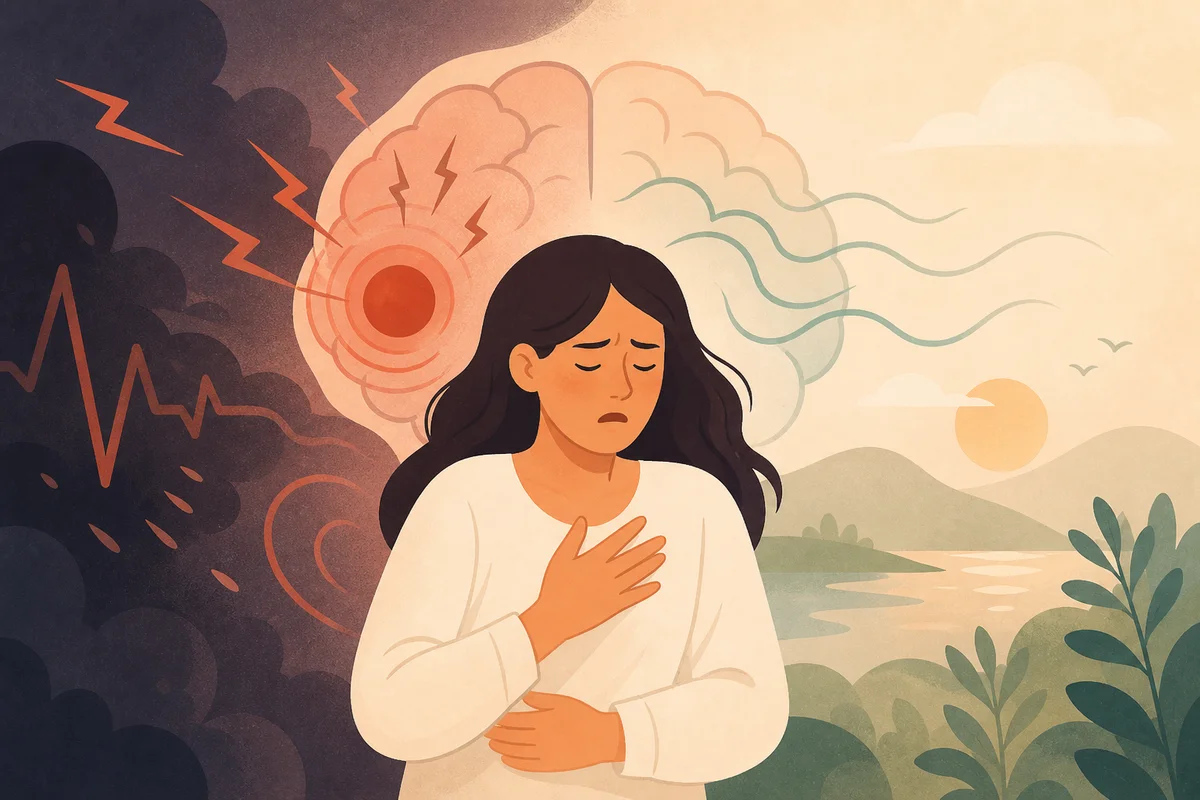
If you have had a panic attack, you know the experience: sudden, overwhelming terror. Racing heart. Chest pain. Difficulty breathing. Dizziness. Tingling. The absolute conviction that something is catastrophically wrong - a heart attack, a stroke, you are losing your mind. And then, after 10 or 20 of the worst minutes of your life, it passes. Understanding what happened in your brain during those minutes will not prevent the next panic attack on its own. But it can change your relationship with it - and that often changes how it lands.
The amygdala alarm fires before you can think
Most panic attacks start in the amygdala - two almond-shaped clusters deep in your brain that function as your threat-detection system. The amygdala processes potential threats faster than your conscious mind can evaluate them. Sensory information reaches the amygdala via a fast, low-level pathway before the prefrontal cortex (your rational thinking center) has time to weigh in.
This speed gap is at the core of panic. The amygdala detects something it interprets as dangerous - a heart flutter, a wave of dizziness, a crowded room, sometimes nothing identifiable at all - and fires the alarm before your thinking brain can assess whether the threat is real.
Neuroscientist Joseph LeDoux described this as the "low road" - a fast, crude threat pathway that bypasses conscious analysis. It exists because in genuine emergencies, the milliseconds saved by not thinking could save your life. But in a panic attack, the system misfires. The alarm is real. The emergency is not.
Once the amygdala fires, it triggers a cascade that conscious effort cannot easily switch off. That is why willpower alone rarely stops a panic attack mid-flight: the threat response started before the thinking part of the brain had time to weigh in.
The sympathetic cascade: what your body does next
The amygdala sends an emergency signal to the hypothalamus, which activates the sympathetic nervous system - your fight-or-flight response. What follows is a coordinated, whole-body mobilization that would be brilliantly adaptive if you were facing a predator. During a panic attack, it is the same system running the same protocol, with no predator in sight.
Here is the cascade, symptom by symptom:
Racing heart: Adrenaline (epinephrine) increases your heart rate to pump blood to your muscles. You feel pounding, racing, or fluttering in your chest. This is often misinterpreted as a heart attack, which can intensify the panic.
Chest tightness and breathing difficulty: Your breathing becomes rapid and shallow (hyperventilation) to increase oxygen intake. But because you are not actually running from danger, the excess breathing can drop your carbon dioxide levels lower than normal, causing chest tightness, tingling, and light-headedness. You feel like you cannot get enough air, even though you are actually breathing too much.
Dizziness and light-headedness: The change in carbon dioxide from hyperventilation can constrict blood vessels to the brain slightly, contributing to dizziness. Blood is also being redirected from non-essential systems toward the large muscles.
Tingling and numbness: Low carbon dioxide can cause tingling in the hands, feet, and face. This is harmless but terrifying when you do not know what is causing it.
Stomach distress and nausea: Digestion shuts down because the body is diverting resources to survival muscles. Blood flow to the stomach decreases, causing nausea, cramping, or that dropping sensation.
Sweating and chills: Your body pre-cools through sweating in anticipation of physical exertion. Some people experience alternating hot flashes and chills as the system oscillates.
Every one of these symptoms has a mechanical explanation. None of them, in a typical panic attack, are dangerous on their own.
The fear-of-fear loop: why panic escalates
One of the most destructive parts of a panic attack is the feedback loop between symptoms and interpretation.
Your amygdala fires. Your heart races. Your conscious mind notices the racing heart and thinks: "Something is wrong with my heart." That thought is a new threat signal - so the amygdala fires again, harder. More adrenaline. Heart races faster. Breathing gets more shallow. Dizziness increases. Now your mind thinks: "I am having a stroke" or "I am going to pass out" or "I am dying."
Each catastrophic interpretation is a new input to the amygdala. Each amygdala response produces stronger symptoms. Each stronger symptom produces a more catastrophic interpretation. The loop accelerates.
This is why panic attacks feel like they are getting worse - because they often are, until they hit the ceiling. And there is a ceiling.
The panic attack is not the amygdala misfiring once. It is the amygdala misfiring, then your fear of the misfire causing it to fire again, and again, in a self-amplifying loop. The fear of the panic attack is often what makes the panic attack severe.
The 10-20 minute ceiling: why panic always passes
This is one of the most important facts about panic attacks: they have a built-in time limit.
Your sympathetic nervous system cannot sustain the fight-or-flight response indefinitely. Adrenaline is metabolized by the body. The adrenal glands have a finite immediate supply. After roughly 10-20 minutes of peak activation, the parasympathetic nervous system typically begins to reassert control - heart rate slows, breathing deepens, the chemical flood recedes.
This happens automatically. You do not have to do anything for it to happen. The panic will usually peak and decline on its own, because that is how the nervous system is designed. It is a sprint response, not a marathon response.
Knowing this does not make the 10-20 minutes pleasant. But it can fundamentally change the experience. Instead of "This is getting worse and will never stop," the thought becomes "This is terrible, but my body will run out of adrenaline within 20 minutes. It always does."
It is also why a trip to the emergency room often coincides with the panic ending. The drive, the wait, the triage - by the time someone evaluates you, the natural time limit on the adrenaline response has usually already kicked in.
Why understanding the mechanism reduces future panic
Psychoeducation about panic - simply learning what is happening in the brain and body - often helps because panic is sustained by the fear-of-fear loop.
When you understand that the racing heart is adrenaline (not a heart attack), that the dizziness is hyperventilation (not a stroke), that the tingling is low carbon dioxide (not nerve damage), and that the whole thing tends to peak and pass within 20 minutes, the catastrophic interpretations lose some power.
With weaker catastrophic interpretations, the amygdala receives fewer secondary threat signals. With fewer secondary signals, the cascade is shorter and less intense. The panic attack still starts, but the amplification loop does not spin up as hard because you are not adding fuel with your interpretations.
This is not positive thinking. It is more accurate thinking replacing less accurate thinking. "I am having a panic attack and my body is running its adrenaline response, which will peak and pass" describes what is actually happening; "I am dying" does not. The accurate version is the one that gives the amygdala less to work with.
Practically: the next time you feel panic rising, try narrating the mechanism to yourself. "There goes the amygdala. Adrenaline is hitting. Heart rate is up because of the adrenaline, not because of a heart problem. Breathing is fast - that is why my hands are tingling. This will peak in a few minutes." You are not calming yourself down by force. You are giving your prefrontal cortex accurate data so it can counterbalance the amygdala.
Anima Felix includes grounding exercises and breathing tools designed for these moments. The calm breathing flow gives your body something to do while the adrenaline runs its course. The grounding exercise pulls your attention into present sensory data. And the chat support lets you process what happened afterward, which can reduce the anticipatory anxiety that builds between attacks. But even without any tool, the knowledge itself can help.
A panic attack is a working alarm responding to the wrong input. Adrenaline runs its course in roughly 10 to 20 minutes whether you intervene or not - knowing that is often what stops you from feeding the cycle while you wait.
Related pages
Frequently asked questions
Can a panic attack actually hurt you? +
In most cases, no. Despite feeling catastrophic, a panic attack is not generally medically dangerous. The symptoms - racing heart, chest pain, dizziness, tingling - are caused by the adrenaline response and hyperventilation, not by cardiac or neurological problems. However, if you are experiencing these symptoms for the first time and are unsure, it is reasonable to seek medical evaluation to rule out other causes.
Why do panic attacks sometimes happen for no reason? +
The amygdala can misfire in response to internal cues you are not consciously aware of - a slight heart rate increase from caffeine, a subtle shift in breathing, a body sensation that resembles a past threat. The trigger is often below the threshold of conscious awareness, making it feel like the panic came from nowhere.
Will panic attacks get worse over time if I do not treat them? +
The attacks themselves tend to follow the same neurological pattern each time. What often worsens is the anticipatory anxiety - the fear of having another attack - which can lead to avoidance behaviors (not going to certain places, not exercising, not being alone). This avoidance can shrink your world significantly. Addressing the pattern early helps prevent this secondary constriction.
How is a panic attack different from an anxiety attack? +
"Panic attack" is a clinical term with specific diagnostic criteria: sudden onset, peaks within minutes, includes physical symptoms like racing heart and breathing difficulty. "Anxiety attack" is not a clinical term but is commonly used to describe a more gradual build of intense anxiety. The key difference is speed of onset and the presence of the acute sympathetic cascade. Both are distressing; panic attacks tend to be more sudden and physically intense.
Author
Sebastian Cochinescu · Founder, Anima Felix
Founder of Anima Felix. Writes about everyday anxiety patterns, practical calming tools, and how conversational product design can support people in anxious moments.
Read author profileWhere Anima Felix fits
If panic attacks are part of your pattern
Anima Felix gives you something to do in the moment - grounding to interrupt the loop, breathing to slow the cascade - and a place to process it afterward so the fear of the next one does not build.
More from the blog
Anxiety Attack vs Panic Attack: What Is the Difference?
Only one of these two phrases is a clinical term. Knowing which is which explains why two people can describe an anxiety attack and mean completely different experiences.
Body symptomsCan Anxiety Cause Diarrhea and Sudden Bathroom Urgency?
Anxiety can change how your gut behaves. The harder problem is usually the loop that forms afterwards, when every trip out starts getting planned around bathrooms.
Mind and bodyCan Nicotine or Vaping Make Anxiety and Panic Worse?
Nicotine feels like it takes the edge off. What it mostly takes off is the edge nicotine put there in the first place.